Initiatives Based on TCFD Recommendations
Governance
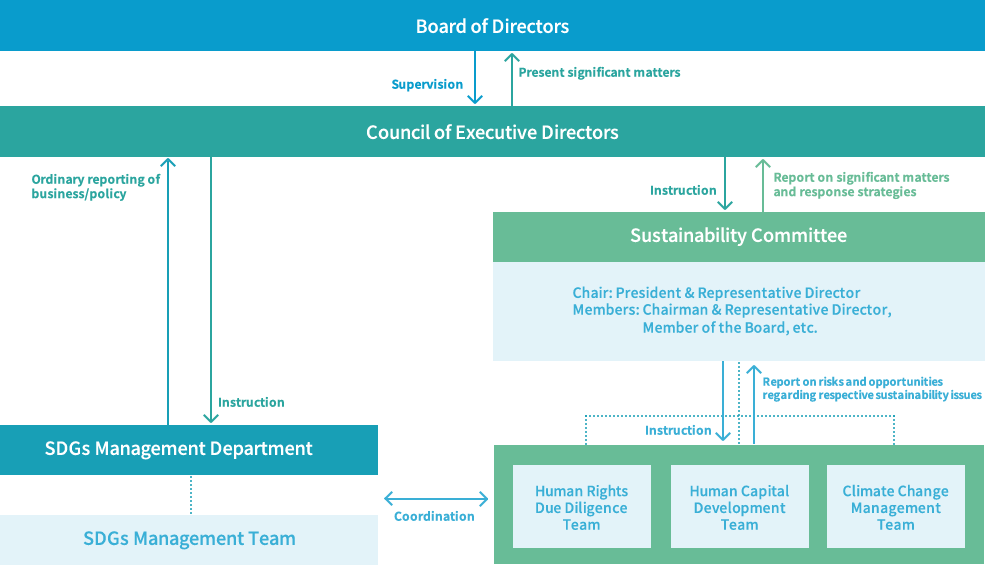
The Group has established the Sustainability Committee that monitors and supervises from a management perspective the sustainability issues that have a large impact on the Group’s sustainable growth and continuity, such as climate change and human capital investment. Under the Committee, the Climate Change Management Team, Human Capital Development Team and Human Rights Due Diligence Team have been established, and their roles are to monitor risks and opportunities as well as deliberate and execute countermeasures. Moreover, important matters related to these issues are deliberated on and determined by the Board of Directors.
Two specific bodies outlined below aim to continuously focus on identifying/assessing and promptly reflecting in business strategies the climate change risks and opportunities that may significantly impact the sustainable growth and continuity of the Group.
Sustainability Committee
The President and Representative Director serves as chair of the Sustainability Committee, which is responsible for monitoring and managing risks and opportunities related to sustainability, including climate change.
Climate Change Management Team
The Climate Change Management Team is composed of general managers and employees from related divisions/departments of TV Asahi Holdings Corporation and TV Asahi. It is responsible for assessing and examining climate change-related risks and opportunities.
Matters deliberated by the Climate Change Management Team are reported to the Sustainability Committee once a year and then reported to the Council of Executive Directors. Matters deemed important by the Council of Executive Directors are presented to the Board of Directors.
Strategy
Utilizing the scenario analysis methodology recommended by the TCFD, the Group has identified and assessed the future risks and opportunities for 2030 from both qualitative and quantitative perspectives. The Group has also considered and implemented measures relating to risks and opportunities deemed to have significant impact. The scenario analysis is based on the following two scenarios:
1. A “Below 2°C” scenario where the impact of transitioning to a low-carbon society is greater than the present.
2. A “4°C” scenario where the physical impacts of climate change are substantial.
1. “Below 2°C” Scenario Analysis
“Below 2°C” scenario
A scenario where the rise in temperature from the Industrial Revolution to the year 2100 is held within 2°C. This scenario assumes global warming is curbed by reducing the increase in atmospheric greenhouse gas levels as a result of government decarbonization policies and regulations that are more stringent than those currently in place and changes in the market.
- Specific scenarios utilized:
RCP2.6 (Source: Intergovernmental Panel on Climate Change (IPCC) “Fifth Assessment Report” (AR5))Net Zero Emissions by 2050 Scenario (Source: International Energy Agency (IEA) “Net Zero by 2050”)
Sustainable Development Scenario (Source: International Energy Agency (IEA) “World Energy Outlook 2019” (WEO 2019))
Analysis findings
The Group’s operating costs would increase as a result of taxation of CO2 emissions from business activities due to the introduction of carbon taxes aimed at reducing greenhouse gas emissions, and a steep rise in electricity prices due to the growing proportion of renewable energy used. If the Group’s decarbonization efforts are deemed insufficient as concern for climate change grows, a decrease in advertisement placements and decline in viewership is expected. Moreover, companies in industries that are vulnerable to transitional impacts to decarbonization are expected to be equally affected by the aforementioned factors.
Measures and Countermeasures
One way the Group is managing the impending carbon taxes and steep rise in electricity prices is reducing power consumption, such as switching to LED lighting. A 50% reduction target from FY21/3 to FY31/3 in the lighting power consumption of studio facilities at the TV Asahi Headquarters Building has been established. The Group is also targeting a 100% renewable energy ratio at the Headquarters Building by FY31/3 through initiatives such as switching to green power.
Moreover, at TOKYO DREAM PARK which opened in March 2026, the Group aims to achieve 100% renewable energy in FY27/3.
On the news reporting front, TV Asahi and BS Asahi became signatories to the SDG Media Compact in July 2020 and February 2020, respectively, and have been making efforts to delivering information that contributes to solving SDG-related issues including climatic and environmental matters. Both companies annually participate in the campaign “Promise of 1.5℃,” which was launched in June 2022 by the United Nations and Japanese companies that are signatories to the SDG Media Compact, and distribute information on a wide range of climate change issues. In addition, the Group regularly implements its own initiative “The Future Starts Here Project x SDGs” Week.
Moreover, the Group will strengthen coordination with companies in industries that are vulnerable to the impacts of decarbonization by enhancing collaboration through monitoring market trends, creating more opportunities for dialogue, and other such efforts.
2. “4°C” Scenario Analysis
“4°C” scenario
A scenario where the rise in average temperature from the Industrial Revolution to the year 2100 is approximately 4°C. It does not assume a transition to decarbonization and is predicated upon current government policies remaining in place, leading to the industries continuing to depend on fossil fuels.
- Specific scenarios utilized:
RCP8.5 (Source: Intergovernmental Panel on Climate Change (IPCC) “Fifth Assessment Report” (AR5))Stated Policies Scenario (Source: International Energy Agency (IEA) “World Energy Outlook 2021” (WEO 2021))
Analysis findings
Under this scenario, domestically, it is expected that extreme weather disasters, particularly storm and flood damages, will be more frequent and severe. Such calamities will impair the Group’s business facilities, news reporting activities, event functions, etc. and shall impact the Group financially. Moreover, revenue will also be impacted if business partners that are susceptible to weather disasters reduce their advertising placements after incurring disaster-related losses or opt to refrain from advertising in the aftermath of disasters.
Measures and Countermeasures
As response to such risks, the Group is working to create and secure a news reporting system to promptly deliver accurate information on and during extreme weather disasters. Specifically, as a reliable media outlet, the Group shall provide timely disaster and meteorological information, archive disaster information, work on improving the Group’s Business Continuity Plan and proactively make Group facilities available for community bases in the event of disasters.
- List of quantitative risks and opportunities
Risk Management
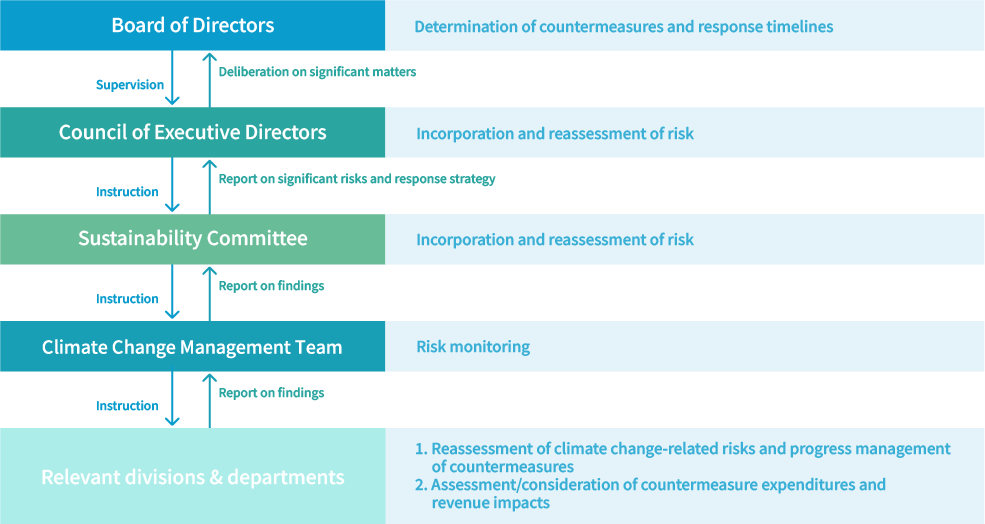
The Group’s climate change-related risk management is conducted by the Board of Directors, Council of Executive Directors, Sustainability Committee, and the Climate Change Management Team.
The Climate Change Management Team receives regular reports from the divisions/departments that the members are from on the following matters and monitors developments.
1. Reassessment of climate change-related risks and progress management of countermeasures
2. The necessity of expenditure on countermeasures and significant impacts on revenue
Findings are also shared with relevant business units within the Company, and deliberations are made on how currently recognized sustainability-related risks are changing, as well as on the need for implementation of additional countermeasures. Matters that need to be reported to the Sustainability Committee are then presented. Upon receiving reports, the Sustainability Committee may seek input from external experts to help determine the need for countermeasures. If the risks are deemed to be significant, the Sustainability Committee will report such matters and response strategies to the Council of Executive Directors. The Council of Executive Directors will incorporate the risk analysis into other sustainability-related and other Group-wide risks and conduct reassessments. Risks that are deemed to be significant will be reported to the Board of Directors for deliberation and the Board of Directors will make final decisions on countermeasures and response timelines.
Key sustainability-related issues and the identification process
Metrics and Targets
The Group uses greenhouse gas (GHG) emissions, electricity consumption, and the percentage of renewable energy used, as indicators to assess and monitor climate change impacts.
The Group is currently discussing its GHG emission reduction target and will disclose the target once established. Efforts to reduce CO2 emissions include utilizing co-generation system services, rooftop greening, taking advantage of daylight through the use of glass exterior walls and installing thermal insulation.
The Group is targeting a 50% reduction by FY31/3 in lighting electricity consumption in its Headquarters Building studio facilities in comparison to FY21/3 levels. Measures such as switching to LED studio lighting are being taken and approximately 450 lights in Studio 3 and Studio 4 were changed to LEDs in January 2021, followed by 115 lights in Studio 5 in January 2023.
Regarding the transition to renewable electricity consumption, the Group has a target to achieve 100% at its Headquarters Building by FY31/3, and has achieved 40% in FY26/3. To achieve the target, the Group is proactively switching to renewable energy, such as switching to green electricity generated from 100% renewable sources.
| FY22/3 results | FY23/3 results | FY24/3 results | FY25/3 results | FY26/3 results | |
|---|---|---|---|---|---|
| Scope 1 | 167.8 (tCO2) | 323.6 (tCO2) | 360.0 (tCO2) | 297.4 (tCO2) | 341.2 (tCO2) |
| Scope 2 | 23,333.3 (tCO2) | 22,744.3 (tCO2) | 22,298.2 (tCO2) | 19,732.8 (tCO2) | 16,622.3 (tCO2) |
Scope of calculation:
TV Asahi Corporation
Asahi Satellite Broadcasting Limited
CS One Ten, Ltd.
The Group voluntarily discloses related information to the extent possible with the aim of communicating with stakeholders. The Group has begun to calculate Scope 3 in addition to Scope 1 and 2. Taking into account the constraints at the initial stage of the calculation, the Group discloses GHG emission intensity (the amount of CO2 released per one million yen of net sales) related to its core business, the broadcasting business, as a reference indicator.
FY25/3: 0.28 tCO2/million yen
FY26/3: 0.26 tCO2/million yen
※The content has been updated on June 26, 2026.
The parts that have been updated from the previous update are underlined.
- Previously Disclosed Information